Approval typically takes 2 to 5 business days. Manual review by the FreeTTS team.
Why we do this
Why we built this program
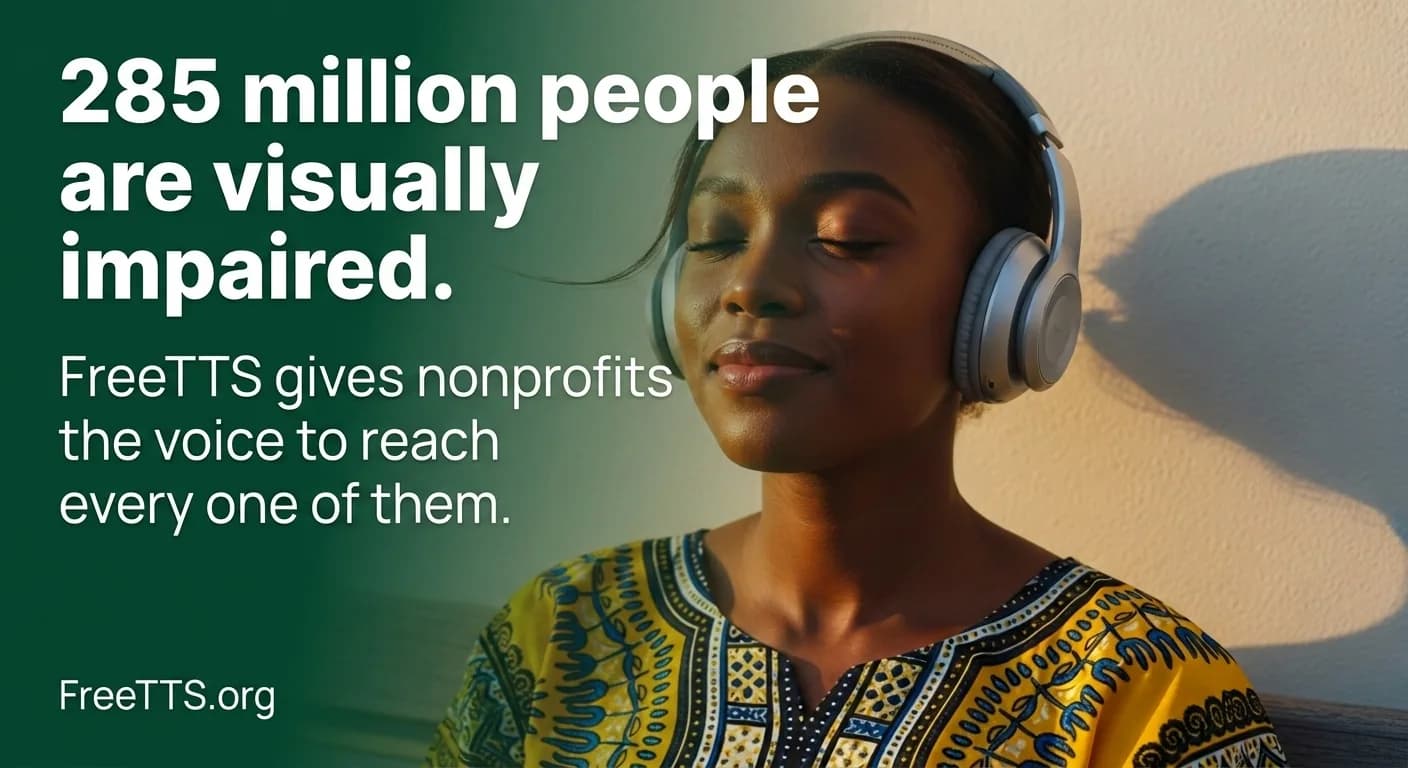
285 million people live with moderate to severe visual impairment, according to the World Health Organization. 763 million adults cannot read in any language. Hundreds of millions more rely on a language they don't yet speak fluently.
The organizations doing the most to reach these audiences, hospital outreach teams, refugee aid offices, accessibility nonprofits, faith-based charities, rural literacy programs, are also the ones with the smallest budgets. Professional voice technology shouldn't be locked behind a paywall they can't justify.
So we made the call: any registered nonprofit, charity, or NGO, anywhere in the world, gets full PRO Lifetime access. Same product paying customers receive. No catches, no time limits, no watermark on month thirteen. We review applications by hand because the orgs that need this most deserve human attention, not a verification API.
The scale
By the numbers
Audiences served by audio-first nonprofit work, plus the size of the eligible nonprofit pool worldwide.
2.2 Billion
people with vision impairment worldwide
Source: WHO World Report on Vision
285 Million
with moderate to severe vision impairment
Source: WHO 2019
763 Million
adults globally cannot read
Source: UNESCO Institute for Statistics
10.2 Million
nonprofits worldwide can apply
Source: GlobalGiving Atlas 2026
In practice
How nonprofits actually use text-to-speech
Real organizations, real outcomes. Patterns we see across thousands of mission-driven teams.
Accessible publishing for blind and low-vision readers
Bookshare, a Benetech program founded in 2001, distributes accessible audio and synchronized text-to-speech books to over 700,000 members in 88 countries across 49 languages. Their library exceeds 1.4 million titles. The audio side relies on synthesized voices because professional narration of every textbook is logistically impossible.
Audio for Indigenous and minority language communities
Wikitongues, the Endangered Languages Project (a Google partnership), 7000 Languages, and similar nonprofits work to preserve languages spoken by communities too small to attract commercial voice talent. Audio versions of stories, teachings, and oral histories in dialects with fewer than 10,000 speakers used to require flying linguists to remote regions with recording gear. AI voices trained on small reference datasets now let these organizations build audio libraries for languages that previously had none.
Cultural heritage, museum, and audio archive nonprofits
The Library of Congress American Folklife Center, Smithsonian Institution, regional history museums, and oral history nonprofits use audio versions of archived documents to make collections accessible to visually impaired researchers and broader audiences. Decades of typed transcripts of veteran interviews, immigrant family histories, and field recordings become listenable archives without re-hiring narrators for every project.
Audio learning for children without textbooks
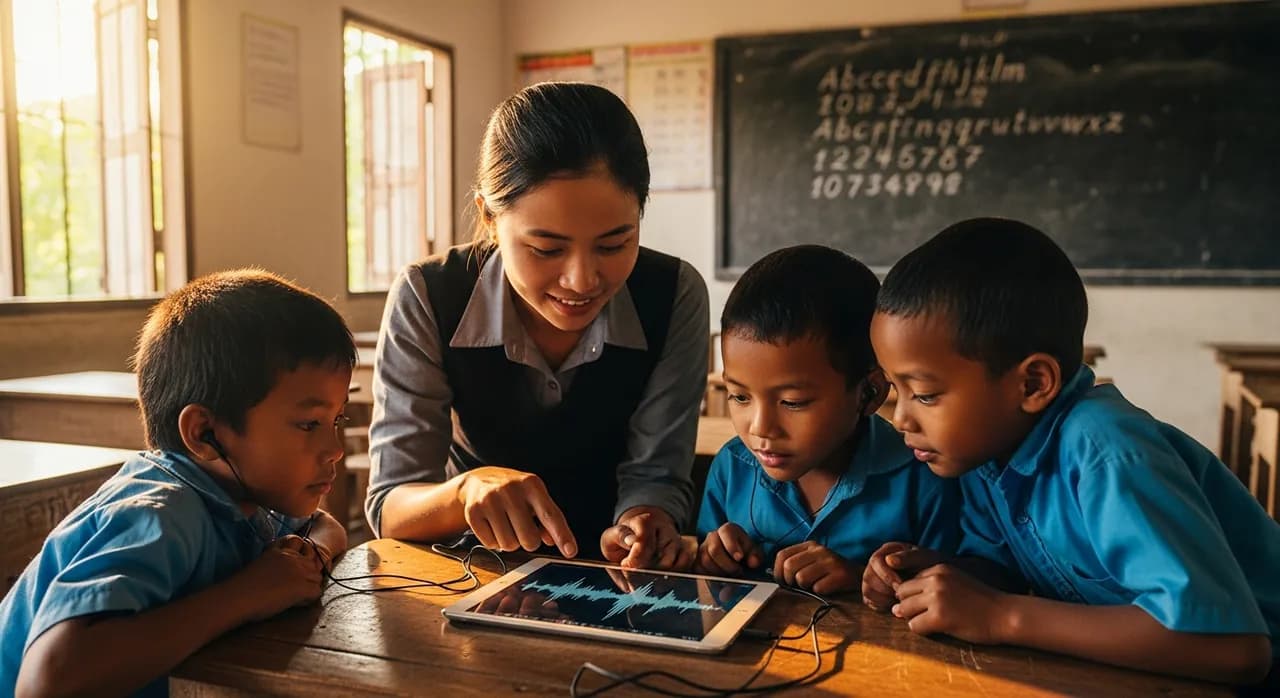
Pratham Education Foundation, founded in India in 1995, reaches over 1 million children annually through audio storybooks and listening libraries that work without home reading support. Room to Read has impacted 40 million children across 15 countries with audio-enhanced literacy programs in local languages. Both rely on multilingual audio that would be impossible to record professionally at this scale.
Daily information access for blind and partially sighted people
The Royal National Institute of Blind People (RNIB), founded in 1868, supports over 800,000 blind and partially sighted people across the UK every year through audio-enabled apps that read news, books, and daily information aloud. The American Foundation for the Blind serves a similar role in the US.
Health education that reaches low-literacy patients
Doctors Without Borders (Médecins Sans Frontières), founded 1971, reaches over 70 million patients across 70+ countries. Many of those patients can't read printed pamphlets. Audio versions of disease prevention guides, immunization schedules, and treatment instructions, often in regional languages, give frontline health workers a tool that doesn't depend on literacy.
Multilingual aid information for displaced families
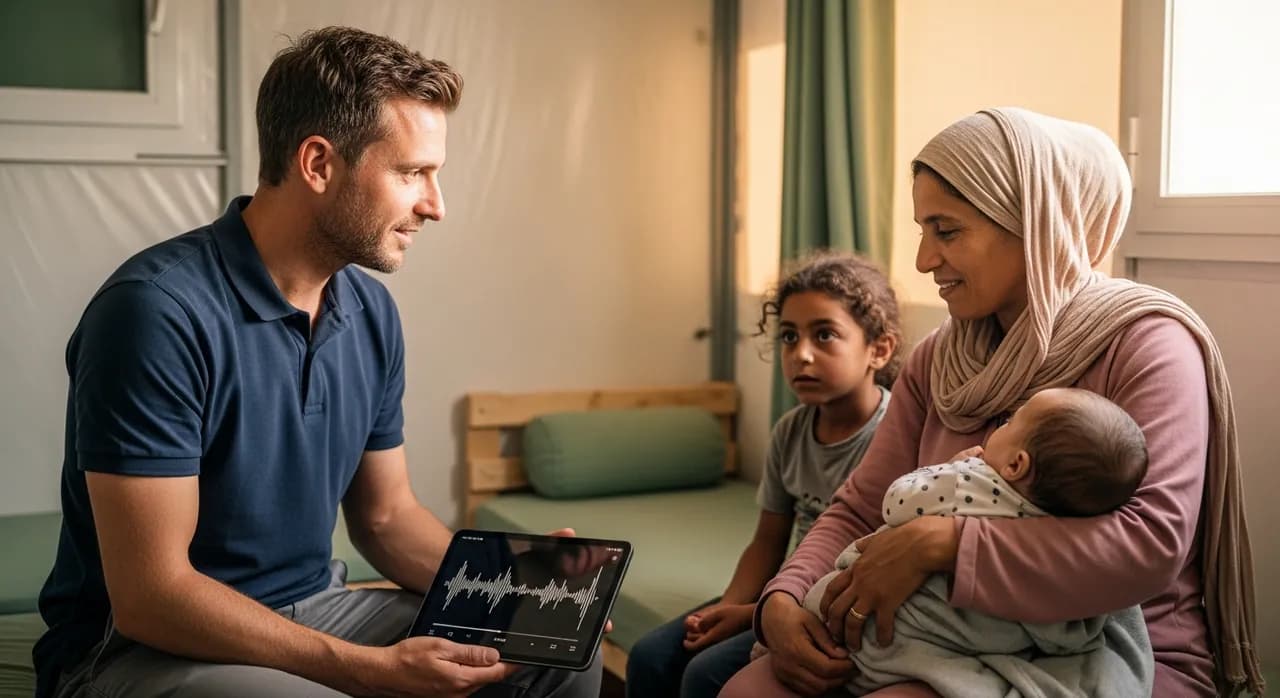
UNHCR, founded 1950, serves over 100 million displaced people across 130+ countries. Many arrive at aid stations speaking only their native language. Audio versions of welcome guides, asylum process explanations, and rights information let aid workers communicate with new arrivals in their actual mother tongue, even when no professional voice actor exists for that dialect.
🕊
Christian charities & Bible societies
Faith Comes By Hearing, founded 1972, has distributed over 200 million audio scripture downloads in more than 2,000 languages across 190+ countries. The American Bible Society reaches similar global scale. Audio Bibles in regional dialects used to take 18 months of studio recording per language. AI voices cut that to days, opening up languages that simply never had audio scripture before.
☪
Islamic charities & Muslim aid organizations
Islamic Relief Worldwide, founded 1984, aids over 10 million people annually across 50+ countries. Their work spans languages from Urdu to Hausa to Bahasa Indonesia, often in communities where studio recording isn't viable. Audio Quran translations, Friday khutbah archives, and humanitarian guidance in regional languages reach blind congregants and non-Arabic-speaking Muslim communities that would otherwise have no audio access.
Audio companionship and continued independence in later life
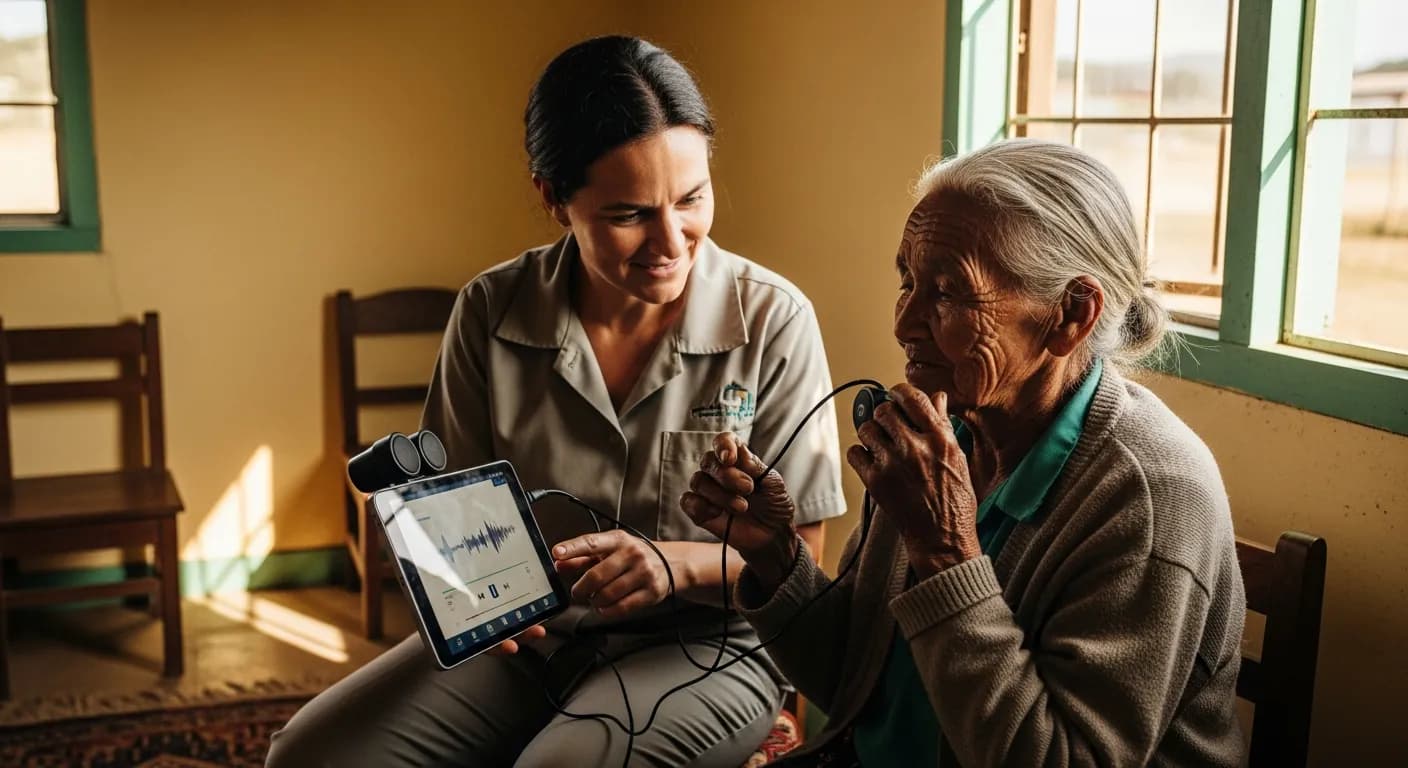
Senior care nonprofits, AARP-affiliated programs, and aging-in-place organizations use audio-enabled apps to maintain independence for elderly people whose vision has declined. Daily news, prescription reminders, family letters, and audiobook libraries become accessible without requiring a sighted caregiver. The independence dividend is significant.
Calm voices for people in crisis
Crisis Text Line and similar nonprofits handle over 200 million conversations from 7 million users in the US, UK, Ireland, and Canada. While the core service is text-based, audio versions of safety protocols, calming exercises, and resource lists serve users in mental health crises who can't focus enough to read. Voice tone matters here in ways video alone can't replicate.
Onboarding and training that includes everyone
The American Foundation for the Blind and similar workplace accessibility groups produce audio versions of HR onboarding, training modules, and accommodation guides. When a new employee with vision loss starts work, they shouldn't have to ask for an audio version of the company handbook. Building it audio-first is the inclusive default.
Audio for environmental and climate nonprofits
World Wildlife Fund, Sierra Club, Rainforest Alliance, and conservation organizations produce audio versions of annual conservation reports, climate education materials, and species protection guides for donors and volunteers who travel without easy reading time. Long-form environmental research becomes commute-friendly content. Multilingual versions reach communities directly affected by climate change in their own languages, where printed materials in English or French often miss the audience.
Evacuation guides and emergency alerts that reach everyone
Red Cross and equivalent national emergency response organizations distribute audio versions of evacuation instructions, disaster preparedness manuals, and emergency alerts to elderly and disabled communities in disaster-prone regions. When power is out and printed materials are unreachable, an audio alert on a battery-powered device may be the only information that arrives.
Compliance
Why audio content isn't optional for many nonprofits
The legal landscape changed in 2024-2025. If your nonprofit serves the public, accessibility compliance is now an operational requirement, not a nice-to-have.
ADA Title II (United States) Updated September 2026
The Department of Justice finalized its Title II rule in April 2024, requiring state and local government agencies, including many publicly-funded nonprofits, to make web content and mobile apps accessible to WCAG 2.1 Level AA standards. Compliance deadlines were extended in May 2026 to give organizations more time: large entities (50,000+ population served) must comply by April 26, 2027. Smaller entities must comply by April 26, 2028. Nonprofits that receive federal or state funding fall under this rule.
ADA Title III (United States)
Private nonprofits operating as places of public accommodation, food banks, shelters, daycares, educational centers, fall under Title III, which requires "effective communication" via auxiliary aids including audio descriptions and TTS-compatible content. WCAG 2.1 Level AA is the de facto legal standard, even though the DOJ has not yet finalized a Title III rule.
European Accessibility Act (EAA) Effective June 28, 2025
The EAA covers digital products and services sold in the EU, including websites, mobile apps, e-books, and audiovisual content. Nonprofits operating in or serving EU residents must provide accessible alternatives. Audio versions of text content satisfy a key requirement.
Section 508 (US Federal)
Federal agencies and any nonprofit receiving federal funding must produce accessible communications, including audio descriptions for video, TTS-compatible web content, and accessible documents.
AODA (Ontario, Canada)
The Accessibility for Ontarians with Disabilities Act has required WCAG 2.0 Level AA compliance since 2021, with WCAG 2.1 expected by 2026.
Penalties for non-compliance range from federal funding loss and DOJ investigations to private lawsuits and fines. For nonprofits, the reputational risk often outweighs the dollar amounts.
What's included
What's included with PRO Lifetime
The same product paying customers get on the $199 Lifetime tier. No watermark, no expiry, no fee.
2,253 neural voices in 149 languages
95 expressive voice styles, including whisper, empathetic, calm, and many others
HD multilingual voices for premium narration
1,000,000 characters per month, roughly 14 hours of finished audio
10,000 characters per single generation
Full commercial license for fundraising videos, paid courses, ads, audiobooks, training
WAV, OGG, and MP3 export
Native SRT subtitle output
Free public REST API at 200 requests per minute
Studio for multi-speaker dialogue and pronunciation libraries
PDF-to-audiobook tool with chapter detection
Chrome extension for right-click TTS on any webpage
Email support, prioritized over the free tier
No paperwork. No verification fee. No "first six months free" trick.
Lifetime means lifetime. We do not revoke access if you grow.
Process
How it works
Three steps. The middle one is on us.
1
Apply
2 minutes
Fill the form below with your organization details. No documents required.
2
We review
2 to 5 days
We check public registries when we can. We may email if we need a quick verifying document.
3
You get access
Locked, forever
Approved? Email arrives with PRO Lifetime activated on your account.
Eligibility
Who can apply
Included
Registered nonprofits, charities, NGOs in any country
Faith-based charities (with secular community service)
Senior care facilities operated as nonprofits
Educational nonprofits and literacy programs
Crisis support and mental health services
Reviewed case by case
Political campaigning or lobbying organizations
Religious organizations whose primary mission is exclusive worship without broader community service
For-profit companies with a charity arm (only the charity arm itself qualifies)
Government agencies (we'd love to talk about a paid plan instead)
Not eligible
Personal use, side projects, or "thinking of starting a nonprofit"
Reselling access to commercial third parties
Accounts shared across multiple unrelated organizations
Apply
Apply for free PRO Lifetime
Form takes about 3 minutes. We read every application by hand.
FAQ
Questions nonprofits keep asking
Who is eligible for free PRO Lifetime?▼
Registered nonprofits, charities, NGOs in any country qualify. We also review case by case for fiscally sponsored projects, social enterprises, and mission-driven orgs without formal nonprofit status. Political campaigning, exclusive religious worship, and for-profit companies don't qualify, even with a charity arm.
Is it really free forever? What's the catch?▼
Genuinely free. No catch. Lifetime PRO means lifetime access to the same product paying customers get for $199. We don't revoke access if your organization grows, we don't add a watermark in month thirteen, and we don't charge a verification fee. Approved applicants pay nothing, ever.
What's the difference between this and the regular paid plan?▼
Nothing. You get the exact same PRO Lifetime tier paying customers receive: 2,253 neural voices, 149 languages, 95 expressive styles, 1 million characters per month, full commercial license, free API access, all of it. The only difference is you don't pay for it.
How long does the application take?▼
Filling the form takes about 3 minutes. Review takes 2 to 5 business days. We check public registries when we can verify quickly. We may email you for a registration document if we need it. Most applicants never have to send anything.
What if my organization is outside the US?▼
We accept applications from any country. Worldwide eligibility was a deliberate choice, the orgs that need this most often work in places where verification frameworks differ. Whatever your country's nonprofit registry is (Charity Commission UK, CRA Canada, ACNC Australia, etc.), provide the equivalent registration number and we'll figure it out.
Can I use FreeTTS voices in fundraising videos and ads?▼
Yes. PRO Lifetime includes a full commercial license. Use the voices in donor outreach videos, paid social campaigns, podcast intros, training materials, audiobooks for sale, anywhere your organization needs audio.
Do I need to upload documents to apply?▼
Not on the form. We try to verify your nonprofit status through public databases (IRS for US, Charity Commission for UK, similar registries elsewhere). If we can't confirm that way, we'll email you asking for a quick document. Most applicants never have to send anything.
What if our nonprofit status changes after we're approved?▼
If your organization loses its nonprofit registration or pivots to for-profit operations, the program no longer applies. We don't actively monitor status, but if it comes up during a periodic review, we'll reach out before changing anything. You'd have the option to convert to a regular paid plan.
My application was denied. Can I appeal?▼
Yes. Reply to the denial email with additional context, documents, or clarification. We'll re-review. Common reasons for initial denial that often resolve on appeal: ambiguous eligibility, missing registration number, or use case that didn't read as mission-aligned.
We're fiscally sponsored. Can we still apply?▼
Yes. Fiscally sponsored projects qualify if you have a clear mission and a fiscal sponsor with verifiable nonprofit status. In the registration number field, list your fiscal sponsor's number and explain the relationship in the description. We've approved many fiscally sponsored projects.
How does FreeTTS compare to the ElevenLabs Impact Program?▼
ElevenLabs offers tier-based discounts for nonprofits with case-by-case terms. FreeTTS gives qualifying nonprofits the same full PRO Lifetime that paying customers get for $199, free, worldwide, no expiry. Voice libraries differ. ElevenLabs has strong English voice realism. FreeTTS has wider multilingual coverage (149 languages, 142 locale variants) and a free public API. Many nonprofits use both. Different strengths for different jobs.
Can I use FreeTTS for audio Bibles or religious content?▼
Yes, for Christian, Muslim, Buddhist, Hindu, Sikh, and other faith traditions. Translate scripture, record sermons, produce devotionals, build educational materials for visually impaired or multilingual congregations. The only restriction is that the org's primary mission has to include broader community service, not exclusive in-group worship.
Can refugee aid organizations use this for multilingual translation?▼
Yes. FreeTTS supports 149 languages. Refugee aid organizations producing welcome guides, asylum process explanations, health information, and rights guides in regional languages get full access at no cost.
Is FreeTTS WCAG 2.1 compliant for our nonprofit's website?▼
FreeTTS produces audio output (MP3, WAV, OGG) that you can embed in your own website. The audio itself is standards-compliant. Whether your website is WCAG 2.1 AA compliant depends on how you implement audio: with proper transcripts, audio descriptions, and player controls. Adding a 'listen to this article' button powered by FreeTTS is a real step toward compliance.
Can multiple staff members share one nonprofit account?▼
One account per organization. Multiple staff members can use it, just don't share credentials publicly or create accounts for unrelated organizations. If your team needs separate user accounts (different histories, different saved projects), reach out, we'll work it out.
Featured
Real nonprofits using FreeTTS
We launched this program in May 2026. The first organizations to apply will be featured here with their permission. If your organization wants to be included, brand exposure on a /nonprofits page that ranks for relevant queries, mention it when you apply.
World Health Organization, World Report on Vision (2.2 billion vision impaired worldwide; 285 million with moderate to severe impairment)
UNESCO Institute for Statistics (763 million adults globally cannot read)
GlobalGiving Atlas, 2026 (10.2 million validated nonprofits worldwide)
Bookshare, Faith Comes By Hearing, RNIB, Pratham, Room to Read, Doctors Without Borders, UNHCR, Islamic Relief Worldwide, Tzu Chi Foundation official impact reports
ADA, WCAG 2.1, Section 508, EAA, AODA official documentation
DOJ Title II final rule, April 2024, and interim final rule, May 2026
We update this page quarterly. Last verified May 2026. No affiliate links. No sponsored content. The application review is done by hand.
Ready to help your audience hear what you have to say?
We genuinely look forward to reviewing your application.